
The Making of Race

Topics in Race and Racism in the United States

Hart M. ZhangAuthor
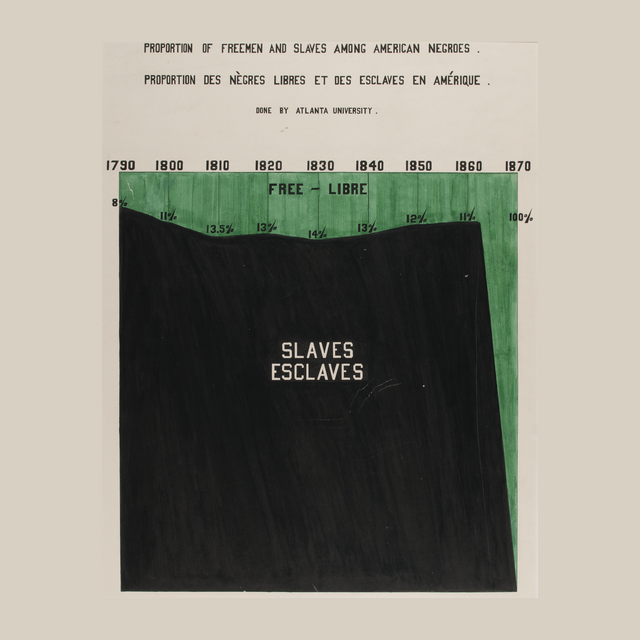
The plate carries a bilingual English–French title — "Proportion of Freemen and Slaves Among American Negroes / Proportion des Nègres libres et des Esclaves en Amérique" — and a credit line, "Done by Atlanta University." A horizontal axis runs from 1790 to 1870 in ten-year intervals. A vast black field labeled "SLAVES / ESCLAVES" fills most of the chart; a thin green band labeled "FREE — LIBRE" sits above it. The percentage of African Americans who were free, by census year, is 8% (1790), 11% (1800), 13.5% (1810), 13% (1820), 14% (1830), 13% (1840), 12% (1850), 11% (1860), and 100% (1870). Between 1860 and 1870 the black field collapses entirely — the chart's record of emancipation.

↑ W. E. B. Du Bois and Atlanta University, "Proportion of Freemen and Slaves Among American Negroes," ca. 1900. Ink and watercolor on board, 71 × 56 cm. From "A Series of Statistical Charts Illustrating the Condition of the Descendants of Former African Slaves Now in Residence in the United States of America." Library of Congress, Prints and Photographs Division. item 2014645356.

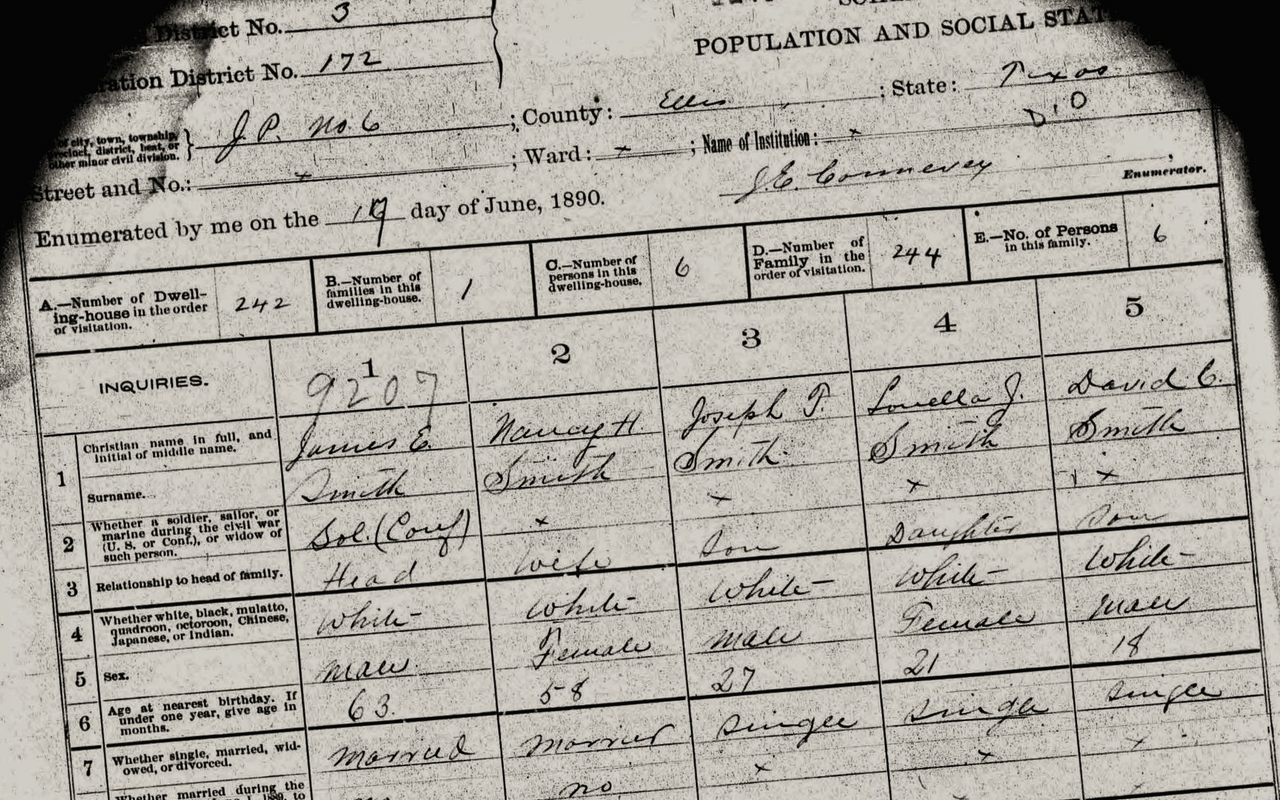
A surviving 1890 U.S. Census page recording the Smith family of Ellis County, Texas. Inquiry 4 reads "Whether white, black, mulatto, quadroon, octoroon, Chinese, Japanese, or Indian." All five family members are entered as "White."

About this Project 🌻

A full course reader on how race has been constructed, contested, and remembered in the United States. The project features 6 modules, 24 units, and 48 standalone case studies, along with study guides, sample syllabi, and assignments. Every unit pairs a brief framing essay with curated readings, primary sources, and discussion questions. Across the modules, these perspectives and materials converge on a shared recognition: race is not a natural fact but a historical and social construction, made and remade through specific institutions, laws, and everyday practices.

At a glance:

  • Standalone units and case studies, easy to adopt and adapt
  • Social annotation and reading groups built into Manifold
  • Student projects featured as contributions from past courses
  • Source files available on GitHub for ongoing OER practices

Work through the modules in order, drop into any unit that interests you, or use the case studies and discussion guides on their own. Whether you are a self-directed learner or an adopting instructor, there is a place for you to explore, adapt, and build on what you find here.
Learn More

For different paths through the material

How to use this resource

If you're studying these materials on your own

Start with Module 1

Work through the six modules in sequence, or follow your curiosity from any unit that draws you. Each unit takes roughly one focused reading session. Annotate as you go, and return to the study guides whenever you need them.

If you're teaching with these materials

Create a Reading Group

Use Manifold's Reading Group feature to build a reader for your syllabus. With six modules, adopt the full sequence or select the units that fit your course, pairing them with case studies and assignments along the way.

If you're using this in community education

Pick a case study

The case studies work as standalone activities for reading circles, organizing meetings, or workshops — no module sequence required. Each is designed to anchor a single session and comes with its own discussion questions.

The Making of Race is built on SOC 250: Racial and Ethnic Communities in the United States, a course taught at Lehman College, CUNY, since 2024. It was developed as part of the Open Education & Publishing Institute (OEPI) in Summer 2026, with support from the Teaching and Learning Center and GC Digital Initiatives at the CUNY Graduate Center, and is published on Manifold @CUNY.