

Omnibus Ciambelli
The Collected Works of Bernardino Ciambelli
The Omnibus Ciambelli is a digital edition of the collected writings of Bernardino Ciambelli (1862–1931), a foundational and complex figure in Italian American literary and cultural history. A journalist, novelist, playwright, and chronicler of immigrant life, Ciambelli wrote across genres and media for more than four decades, producing serialized fiction, newspaper columns, and works for the popular stage that circulated widely among Italian communities in the United States.
The project also serves as a digital companion to The Trials of Migration (I drammi dell’emigrazione, 1895), the first complete English translation of a work by Ciambelli, translated by Stefano Morello and critically annotated by Morello and Martino Marazzi, forthcoming from Agincourt Press.
Despite Ciambelli’s popularity among contemporary readers and his importance to scholars of Italian American culture, much of his writing has remained difficult to access, dispersed across archives, libraries, and private collections in the United States and Italy. The Omnibus is the product of an ongoing effort to locate, preserve, transcribe—and occasionally edit—these scattered materials, to make it possible to encounter Ciambelli’s work as a corpus, in all its breadth and disorder.
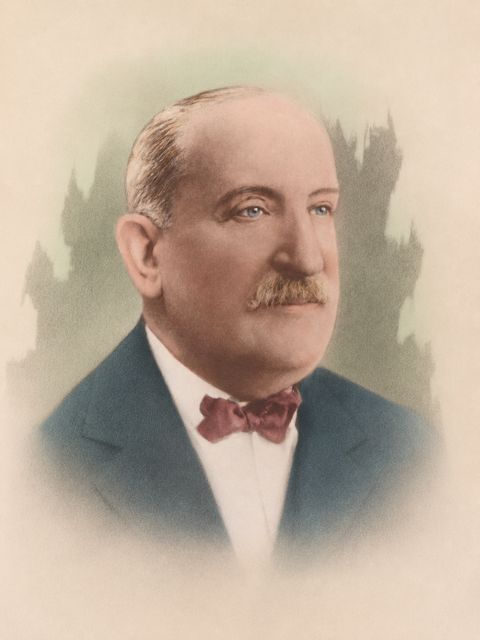
Bernardino Ciambelli 1917 circa, Courtesy of Michael Rehfus
Texts
Novels
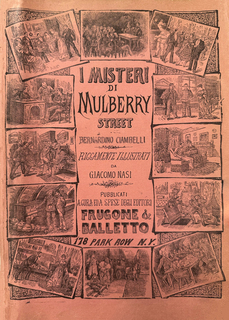
I Misteri di Mulberry Street
I Misteri di Mulberry Street (The Mysteries of Mulberry Street), the first episode of a trilogy that continues with I Drammi dell’Emigrazione (1894) and I Misteri dei Bosses (1895), follows Vittoria Ruiz, a young Neapolitan woman who arrives in New York with her son in search of the husband who abandoned them. Soon after landing, she falls into the hands of traffickers who prey on newly arrived immigrant women and is unknowingly sold to her own husband, Renato, now living as the prosperous merchant Ruizzi. His attempt to silence her sets in motion a melodramatic tale that revolves around organized crime, vice, and the exploitation of Italian laborers. As former police inspector Augusto Boni and his allies work to expose Renato’s past and to restore justice, the narrative moves from the Italian colonia of Lower Manhattan to Blackwell’s Island, Sing Sing, and the phosphate mines of South Carolina.
Published- This text has 0 annotations
- This text has 0 highlights
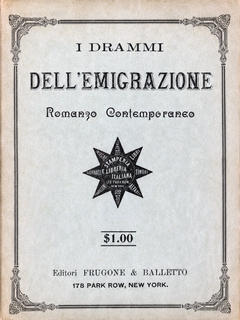
I Drammi dell’Emigrazione
I Drammi dell’Emigrazione (The Trials of Migration), the second episode of Ciambelli’s trilogy, follows a group of Italian migrants from the mountain village of San Gregorio to New York. Their journey is brokered by Giuseppe Nelli, a labor boss who returns from America posing as a prosperous “American” and recruits twenty-three villagers with promises of work and fortune. Among them is Rosa, the wife of his cousin Gennarino, whom Giuseppe draws into an affair. Their story intersects with those of the painter Ernesto Baldi and the criminal aristocrat Carlo di Rialto during the Atlantic crossing and after their arrival in New York. In the United States, dreams of prosperity give way to poverty, exploitation, and the trials of immigrant life, while Augusto Boni and other characters from the first novel become entangled in the newcomers’ stories.
Published- This text has 0 annotations
- This text has 0 highlights
Amore, Lussuria, Morte, ovvero il Processo di Antonio Bianco (incompleto)
Amore, Lussuria, Morte, ovvero Il processo di Antonio Bianco centers on a fraught love triangle in Stella, a small village in the Cilento region. Antonio Bianco, a destitute tailor besotted with Drusiana, believes his happiness assured when she agrees to marry him. But Drusiana is also desired by Gabriele Bertolino, the wealthy young son of the family for whom her mother works. Torn between the emotional security offered by Bianco and the social advancement a marriage to Gabriele might bring, Drusiana becomes the focus of jealousy, desire, and class conflict whose consequences threaten to turn love into ruin. Originally issued in dispense (weekly installments) by the New York-based publishers Frugone & Balletto in 1894, the novel was republished serially in the daily L’Indipendente (New Haven, CT) beginning in February 1916. Only a few installments of this later serialization survive in the archive.
Published- This text has 0 annotations
- This text has 0 highlights
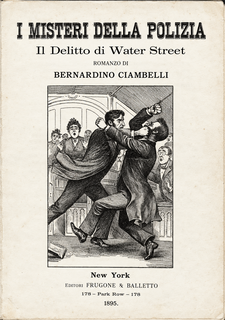
I Misteri della Polizia: Il Delitto di Water Street
The second installment in the I Misteri della Polizia (The Mysteries of the Police) series, Il delitto di Water Street (The Water Street Murder) (Frugone & Balletto, 1895) opens with the murder of the wealthy Annie Porter Anderson, killed by her son George during a dispute over money. Suspicion instead falls on Henry Stuart, Annie’s loyal steward and Rosie’s adoptive father, while the real murderer is shielded by a web of blackmail and complicity that extends into the police force itself. Shuffling across the mansions of Fifth Avenue to the saloons, gambling houses, and brothels of Lower Manhattan's immigrant neighborhoods, Ciambelli portrays a New York City in which wealth, crime, lust, and institutional corruption are constitutive of the urban fabric. The series included three other installments: I falsi monetari (1895), Le tane di New York (1895), and I briganti americani (1896); as of 2026, however, no copies of these texts are known to survive in extant archives.
Published- This text has 0 annotations
- This text has 0 highlights
L’Aeroplano Fantasma (incompleto)
L’Aeroplano Fantasma was serialized in La Follia di New York beginning September 24, 1911. The story follows George Robin, an inventor who discovers a revolutionary fuel capable of transforming automobile and airplane engines. His assistant, Alfonso Rodriguez, driven by envy, greed, and desire for Robin’s wife Luisa, forges a letter suggesting Luisa’s infidelity, steals Robin’s formula, and sets in motion a domestic tragedy that leaves Luisa wounded and mentally incapacitated. Convicted of attempted murder, Robin is sent to Sing Sing, while Rodriguez claims the invention as his own, becomes wealthy and celebrated in New York City society. From prison, Robin begins plotting his escape and the recovery of his life and reputation. The surviving text is incomplete, as the installments published in 1912 are lost.
Published- This text has 0 annotations
- This text has 0 highlights
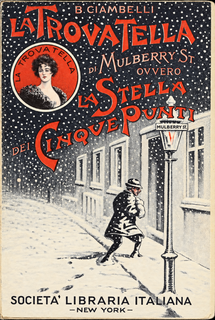
La Trovatella di Mulberry Street, ovvero La Stella dei Cinque Punti
La Trovatella di Mulberry Street tells the story of Luigina, the secret daughter of wealthy heiress Annie Richardson, abandoned as an infant on Mulberry Street and taken in by Baciccia and Cherubina, two Ligurian immigrants who raise her as their own in the Five Points. Fifteen years later, Luigina has become the “Star of Five Points,” admired for her beauty, generosity, and musical talent. Around her, Ciambelli weaves a plot of love, rivalry, and deception that carries the story from the Italian neighborhoods of New York to the Paris of the Universal Exposition and imperial Russia. Luigina’s struggle with tuberculosis, and the conflict between competing approaches to medicine, unfolds alongside Annie’s attempts to reconnect with Luigina.
Published- This text has 0 annotations
- This text has 0 highlights
Metadata
- publisherManifold @CUNY
- publisher placeNew York, NY