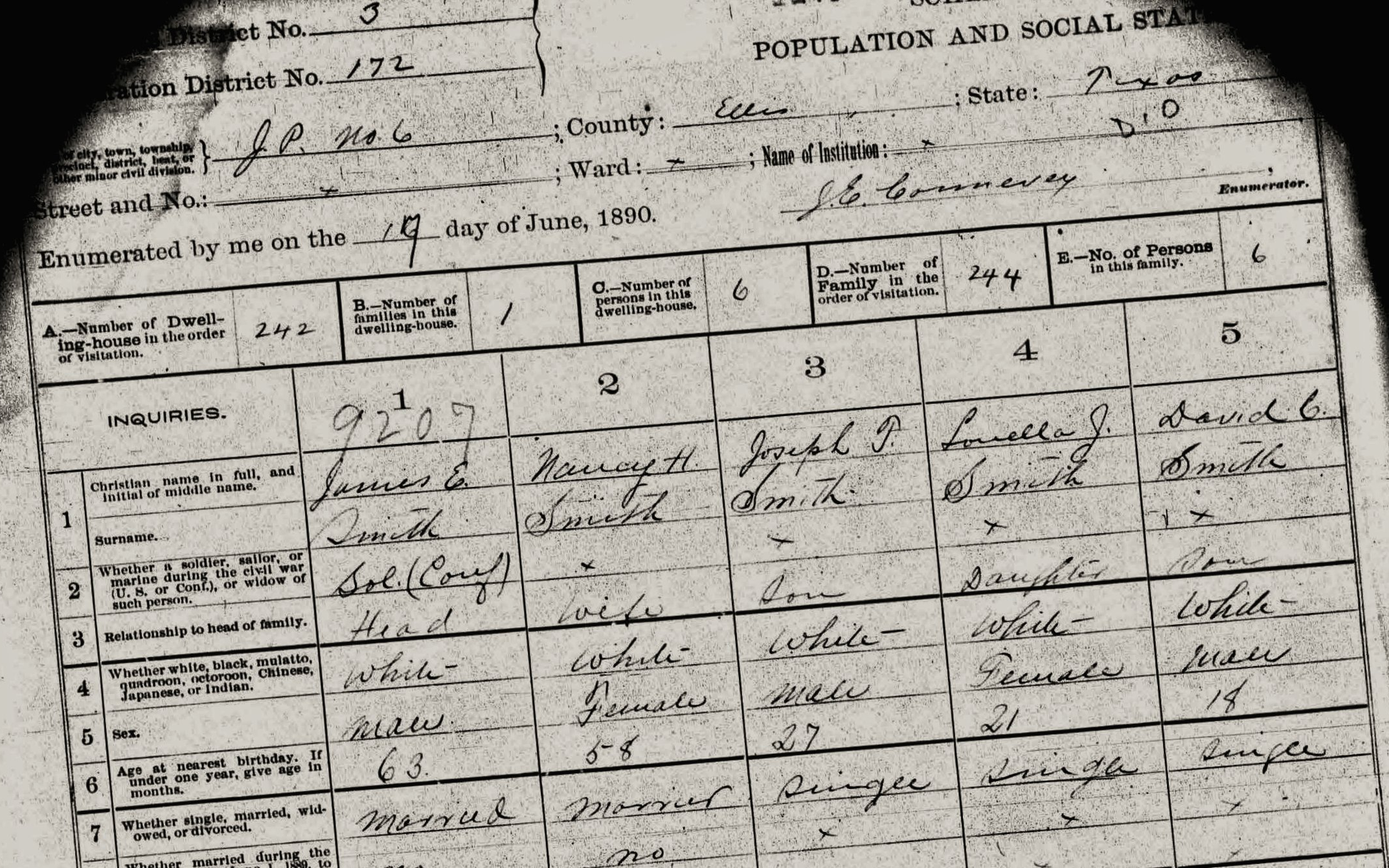
The image on this project's cover is a single page from the 1890 U.S. Census — one of approximately 6,160 names that survived a fire in 1921 that destroyed records for the remaining 62,973,606 people enumerated that year. The page records the Smith family of Justice Precinct No. 6, Ellis County, Texas, enumerated by J.E. Conaway on June 19, 1890. It is shown here not because the Smith family is famous, but because the document itself is evidence — visible, specific, dated, signed evidence — of what this project means by "the making of race."
What you're looking at
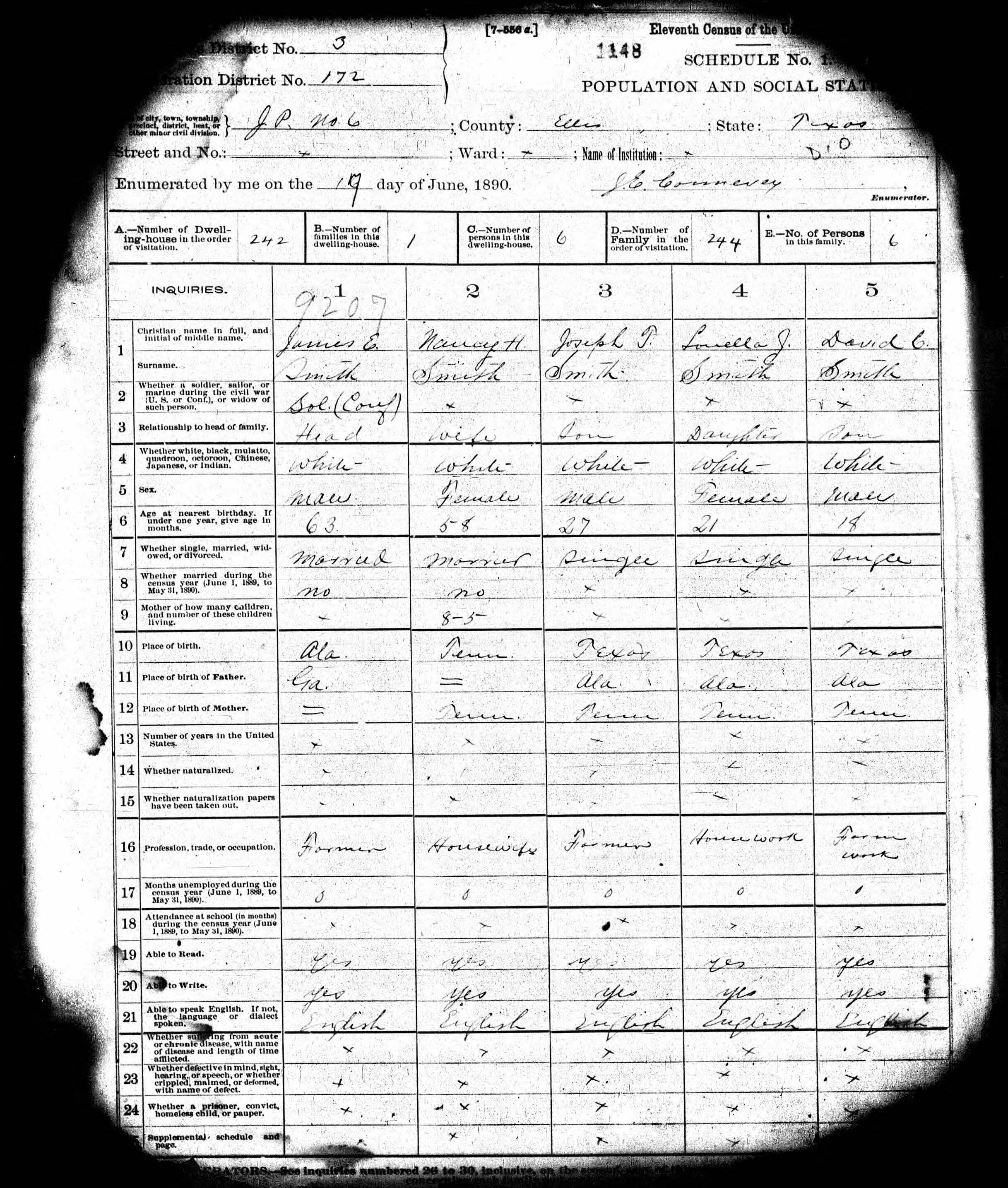
The form is the Eleventh Census of the United States, Schedule No. 1: Population and Social Statistics. Each person in the household gets a column; each row is one of twenty-four "Inquiries." Reading down the visible portion: Christian name, surname, war service, relationship to head of family, and then — Inquiry 4 — the question that gives this project its title:
Whether white, black, mulatto, quadroon, octoroon, Chinese, Japanese, or Indian.
All five visible members of the Smith household are entered as "White." James E., the head of household, is 63 years old, a farmer, born in Alabama, the son of Georgia parents. His wife Nancy H. is 58, born in Tennessee. Their three adult children — Joseph P. (27), Louella J. (21), and David E. (18) — were born in Texas, where the family had settled by the time of enumeration. The form also notes that James served as a soldier ("Sol. Conf.") — a Confederate veteran in 1890, twenty-five years after the war.
The categories that aren't there anymore
The 1890 Census was the only U.S. Census to use the seven-category racial taxonomy printed on this form. Two of those categories — "quadroon" and "octoroon" — were added in 1890 and removed by 1900. They were attempts to fractionalize Blackness: one-quarter Black ancestry for quadroon, one-eighth for octoroon. Federal enumerators carried instructions on how to assign these categories based on visible features and family knowledge.
Read the categories together — white, black, mulatto, quadroon, octoroon, Chinese, Japanese, or Indian — and what you see is the racial logic of the late nineteenth-century American state: Blackness measured in fractions, "Chinese" and "Japanese" listed alongside continental categories rather than under a broader heading, "Indian" rather than the names sovereign Indigenous nations used for themselves. None of this came naturally. Each was a decision, debated and printed and distributed to 46,000 enumerators.
By 1900, the categories changed. Quadroon and octoroon were dropped. In 1930, "Mexican" appeared briefly and disappeared again. The Census has been redrawn every decade since, and the categories have never settled into the natural form that day-to-day usage often suggests. This is the historical claim that Module 1 of this project develops: racial categories are state instruments, made and remade.
Why this page survived
The 1890 schedules were stored on wooden shelves in the basement of the Department of Commerce building in Washington, DC. On the afternoon of January 10, 1921, a fire broke out — possibly from a discarded cigarette, possibly from faulty wiring, no one was ever sure. Firefighters poured thousands of gallons of water into the basement; on the floor above, workers cut holes in the floor and dumped more. By 9:45 p.m. the fire was out. By the next morning, Census Director Samuel Rogers was standing in ankle-deep water amid heaps of charred and water-soaked paper.
Most of the 1890 Census was destroyed. The schedules that weren't burned outright continued to decay in their water-damaged piles through 1921 and into the years that followed. In December 1932 the Census Bureau reported to Congress that the unsalvageable remainder should be destroyed, and Congress authorized their disposal on February 21, 1933. Of an estimated 62,979,766 people enumerated in 1890, surviving fragments now record 6,160 — roughly one out of every ten thousand.
The surviving fragments were eventually microfilmed by the National Archives as Microfilm Publication M407, three rolls. Roll 3 includes the Texas counties — Ellis, Hood, Rusk, Trinity, and Kaufman — and within Ellis County, the Justice Precinct No. 6 page enumerating the Smith family.
That this particular page survived is the result of three accidents: it was in a bundle that didn't burn outright, the bundle wasn't completely destroyed by water, and someone, decades later, decided that what remained was worth preserving. The number "1148" handwritten on the top edge is a Census Bureau working number that places it among the small set of pages catalogued after the rest was gone.
What this document does for the project
Every other source in The Making of Race tells you that racial categories were invented and have changed over time. This one shows you the invention happening on a specific date, in a specific room, in a specific hand. The taxonomy printed on the form — white, black, mulatto, quadroon, octoroon, Chinese, Japanese, or Indian — was distributed by the federal government to 46,000 enumerators with instructions on how to apply it. The handwriting in column 4 is one of those enumerators making the decision for one household in Texas. Multiply that handwriting by the 62.9 million people who were enumerated and you have the apparatus by which the state taught a country what race was, in the year 1890. That apparatus is what the project is about.
That this fragment also happens to be one of the rare physical artifacts left from a near-total archival loss makes it doubly suitable as the cover image. It is both the kind of thing we are studying and a reminder of how much we will never see.
Full archival citation
James E. Smith household, Justice Precinct No. 6, Ellis County, Texas, enumerated June 19, 1890 by J.E. Conaway. Eleventh Census of the United States, 1890 — Schedule No. 1: Population and Social Statistics, surviving fragment 1148. NARA Microfilm Publication M407, Roll 3 (NAID 2353580), Records of the Bureau of the Census, Record Group 29, National Archives and Records Administration, Washington, DC. Image via U.S. Census Bureau, History and the Census: 1890 Census Fire (January 2021). Public domain (work of the U.S. federal government).
Sources and further reading
Primary sources
- NARA Microfilm M407, Eleventh Census of the United States, 1890 (3 rolls). archives.gov/research/census/1890.
- U.S. Census Bureau. "History and the Census: 1890 Census Fire" (January 2021). census.gov.
- High-resolution image of the Smith family page (U.S. Census Bureau). census.gov image file.
Scholarship and history
- Schor, Paul. Counting Americans: How the United States Census Classified the Nation. New York: Oxford University Press, 2017. Publisher Page.
Book.
A comprehensive history of racial and ethnic classification on the U.S. Census from 1790 through 2000, translated from the French. Especially detailed on the bureaucratic and statistical reasoning behind specific category changes, including the 1890 schedule's seven-category taxonomy.
- Anderson, Margo J. The American Census: A Social History. 2nd ed. New Haven, CT: Yale University Press, 2015. Publisher Page.
Book.
The standard social history of the U.S. Census from 1790 to the present, including the political context surrounding the 1890 schedules and the 1921 fire that destroyed most of them.
- Prewitt, Kenneth. What Is Your Race? The Census and Our Flawed Efforts to Classify Americans. Princeton, NJ: Princeton University Press, 2013. Publisher Page.
Book.
An accessible account of the Census's racial classification practices written by a former Director of the U.S. Census Bureau. Useful for general readers and adopting instructors who want a non-academic supplement to the scholarly literature.
- Hochschild, Jennifer L., and Brenna Marea Powell. "Racial Reorganization and the United States Census 1850–1930: Mulattoes, Half-Breeds, Mixed Parentage, Indians, and the Mexican Race." Studies in American Political Development 22, no. 1 (2008): 59–96. View the Article.
Journal article.
A political-historical account of how racial categories on the U.S. Census were reorganized between 1850 and 1930, with sustained attention to the 1890 quadroon and octoroon categories and the political processes that produced them. Directly on point for the form printed on this cover image.
- Snipp, C. Matthew. "Racial Measurement in the American Census: Past Practices and Implications for the Future." Annual Review of Sociology 29 (2003): 563–588. View the article.
Review article.
A review article tracing how racial categories have been measured on the U.S. Census across its history, with attention to the political and demographic stakes of each redrawing. Useful as a single-source overview for readers approaching the topic for the first time.
- Nobles, Melissa. Shades of Citizenship: Race and the Census in Modern Politics. Stanford, CA: Stanford University Press, 2000. Publisher Page.
Book.
A comparative-historical study of how the United States and Brazil have used their censuses to produce racial categories, and how those categories shaped citizenship and politics in each country. The theoretical anchor for the claim that the census makes race rather than merely measures it.
- Blake, Kellee. "First in the Path of the Firemen: The Fate of the 1890 Population Census." Prologue: Quarterly of the National Archives 28, no. 1 (Spring 1996). archives.gov.
Journal article.
The standard archival history of the 1921 Commerce Department fire and the destruction of the 1890 Census schedules, written by an archivist at NARA. Details how the fire began, what was lost, and how the surviving fragments came to be catalogued.