Empowering Change: Innovative Public Education Models for Inclusive, Equitable, and Sustainable Lutherie Practices in Argentina and Brazil
Rubens De La Corte*
Introduction
In this paper, I argue that the evolution of lutherie[1] education is crucial for ensuring the sustainability and relevance of musical instrument making in today’s rapidly changing musical landscape. I posit the following questions: How can the transition from traditional apprenticeships to structured academic frameworks that integrate theoretical knowledge with hands-on experience be successful? What role do public educational institutions play in fomenting a new generation of skilled luthiers committed to sustainability and innovation? As I examine these themes, I will highlight the importance of multidisciplinary approaches, inclusivity, and equity in educational settings. Ultimately, how can the lutherie education framework evolve to meet the needs of aspiring luthiers, musicians, and the dynamic music industry?
Lutherie education at public universities in Argentina and Brazil is undergoing a significant transformation, integrating innovative and sustainable practices to meet the rising demand for skilled luthiers. This shift from traditional apprenticeships to structured academic programs emphasizes sustainable sourcing and eco-friendly technologies, fostering interdisciplinary learning and environmental responsibility. Case studies examined during fieldwork in San Miguel de Tucumán, Neuquén, and Buenos Aires, Argentina, as well as in Curitiba, Brazil, between June and September 2025, showcase successful collaborations that address societal challenges. By focusing on sustainability and innovation, public universities are poised to shape the future of lutherie, balancing craftsmanship with ecological and economic considerations.
Knowledge Integration, Collaboration, and Educational Reform
Knowledge integration is essential for effective transdisciplinary cooperation and addressing complex real-world challenges, as emphasized by Jasmin Godemann (2008). Godemann argues that establishing a shared cognitive framework can facilitate consensus across diverse fields, allowing teams with varied expertise to come together and develop innovative solutions. However, the clash of distinct epistemologies often hinders this process unless teams commit to developing meta-knowledge and trust. Additional insights from Tina Lynn Evans (2015) build on this by asserting that grounding sustainability education in place-based contexts enhances efficacy, enabling cross-disciplinary teams to address local needs. Evans highlights the role of deep generalists, facilitators who connect different disciplines, stresses the importance of institutional leadership, and the dismantling of academic silos in creating environments conducive to collaboration and inclusive dialogue while engaging in community partnerships to tackle pressing socio-ecological issues.
Cagatay Tasdemir and Rado Gazo (2020) advocate for integrating sustainability into higher education with a focus on holistic systems thinking that interlinks social, environmental, and economic dimensions. They emphasize the importance of co-creation with stakeholders and project-based learning that yields actionable solutions to concrete challenges. On the artisan front, Lisa M. Grobar (2017) argues for robust policies supporting the handicraft sector to preserve cultural heritage while promoting economic development, advocating for context-specific strategies that empower artisans, particularly women and informal workers.
Judy Frater’s extensive work (2019, 2020) on the sustainability of craft traditions emphasizes reconfiguring value creation around artisan agency and the importance of collaborative networks. Frater contends that the artisan crisis stems from an erosion of relational value in favor of standardized production, making the rebuilding of equitable networks crucial. Furthermore, Frater highlights formal education as a co-creative process that fosters both technical skills and market literacy, enabling artisans to innovate within their cultural frameworks while reinforcing authenticity through strong maker networks. Moreover, Frater also explores the complex dynamics between tradition and market forces, noting how gender-mediated consumer relationships can impact creative authority. This duality underscores the need for targeted interventions that promote social equity while preserving craft traditions.
Lastly, Taining Xing and Nailiang Chen (2024) discuss the evolution of educational models in musical instrument manufacturing, illustrating how historical craftsmanship can be enriched through formal curricula that incorporate advanced manufacturing technologies such as CAD (computer-aided design) and CNC (computer numerical control). This integration ensures that educational practices remain relevant to industry demands while preserving traditional techniques. Integrating knowledge within lutherie education is essential for addressing interdisciplinary challenges, especially in public universities. By incorporating diverse perspectives and methodologies, educational programs can generate innovative solutions that combine practical skills with academic insight. Effective integration requires overcoming epistemological differences between practitioners and educators, necessitating structured exchanges that unify diverse knowledge systems. Communication skills play a crucial role in fostering collaboration among luthiers, academics, and industry experts, ultimately preparing students for everyday challenges. Collectively, these authors present a compelling case for integrating diverse knowledge systems, establishing collaborative frameworks, and reforming education to sustain cultural and environmental legacies, while also addressing the challenges posed by globalization and market demands for artisans.
Sustainability Within Lutherie
The investigation of sustainability in lutherie reveals a complex interplay among materials, culture, and ecological practices, underscoring the need for an integrative approach to instrument making. Kevin Dawe (2015) highlights the importance of material choice, noting that engagement with diverse materials impacts not only sonic qualities but also embodies local ethical practices that prioritize sustainability while minimizing environmental impact. Expanding on Dawe’s ideas, J. Martinez-Reyes (2021) introduces the concept of enviromateriality, urging luthiers to reconsider sourcing and consumption informed by colonial histories and to integrate social justice with ecological integrity. Supporting this notion, Rebecca Dirksen (2019) advocates for a participatory ecomusicology framework that honors environmental health and cultural memory, empowering local communities to make informed decisions regarding resource management. Joshua Tucker (2016) calls for a holistic view of sustainability through socio-material assemblages, recognizing the agency of non-human actors in the craft. Keisuke Yamada (2017) emphasizes the need for context-specific preservation strategies that respect the significance of materials sourced from prohibited or endangered species, advocating for innovation that aligns with cultural values.
Moreover, Chris Gibson and Andrew Warren (2021) stress the importance of understanding material inheritances and conservation, arguing that authentic innovation must maintain the relationship between instrument design and maker skills while integrating alternative materials without compromising traditional practices. They highlight the role of interdisciplinary education, combining forestry science, ecology, ethics, and market dynamics, to prepare students for complex narratives surrounding provenance and resource management. They also note the emergence of resource-sensitive global production networks, underscoring the significance of partnerships among tonewood suppliers, regulators, and artisans, which facilitate collaborative responses to environmental crises and enhance transparency in material sourcing. By promoting principles of biodiversity and regeneration, and reevaluating economic incentives and governance structures, the field of lutherie can move toward ethically informed practices that respect ecological limitations and cultural integrity, ensuring a sustainable future for instrument making.
I argue that public universities in Argentina and Brazil are pioneering sustainability in lutherie curricula by merging traditional craftsmanship with modern techniques. These programs cultivate critical thinkers and cultural innovators who evaluate their ecological impact while encouraging artisan collaboration and community-building initiatives. Although integrating sustainability presents challenges, it also creates opportunities for innovation through interdisciplinary approaches in Environmental Science, Business, and Acoustics. By emphasizing systems thinking and engaging students with industry professionals in project-based learning, these educational models promote responsible craftsmanship and ethical production, ensuring the continued relevance of lutherie in ever-changing environments.
Case Studies: Diversity, Sustainability, and Identity
This section delves into three enlightening case studies that illustrate the intersection of lutherie, sustainability, and identity across different cultural contexts. Through innovative lutherie programs, universities in Argentina and Brazil are not only nurturing musical talent but also fostering an awareness of environmental responsibility and cultural legacy. From traditional instrument-making techniques that emphasize local woods to initiatives aimed at reviving and preserving rare materials, these case studies reflect a broader commitment to sustainability and inclusivity in lutherie education. This holistic approach enables the next generation of luthiers to engage meaningfully and sustainably with their cultural heritage, ensuring that the art of instrument-making evolves in harmony with the local environment and society.
I. Universidad Nacional de Tucumán (UNT) – San Miguel de Tucumán, Argentina
The Escuela de Luthería at the Universidad Nacional de Tucumán (UNT), founded in 1949 by Italian luthier Alfredo Del Lungo, was established to address local musicians’ interest in lutherie and to support the university’s symphony orchestra with instrument conservation. Renowned for his work, including the reconstruction of the Viola Medicea by Stradivarius, Del Lungo positioned the school as Latin America’s premier institution for lutherie education, a status it maintains to this day. The UNT Lutherie Department offers three undergraduate programs, including a five-year Bachelor’s and two Professional Technical degrees, with classes conducted in person for over 100 students. Celebrating its 75th anniversary, the program solidifies Tucumán’s reputation as a global lutherie hub, second only to Cremona, Italy.
The bachelor’s degree in Lutherie is a 5-year program that equips students with both practical skills and theoretical knowledge in crafting and maintaining string instruments. The first year lays the groundwork with guitar construction, ear training/audio perception, wood technology, and technical drawing, alongside historical context and guitar playing. In the second year, students refine their guitar skills and delve into the restoration of plucked instruments and Latin American folk instruments, while emphasizing artistic drawing and design. The third year introduces violin making and focuses on advanced lutherie techniques, with musical performance on violin or cello. The fourth year continues with viola lutherie, the restoration of bowed instruments, and research projects in the field. The final year centers on cello, covering practical lutherie, bow construction, and performance refinement, alongside a thesis that explores the intersection of art and culture, reflecting their comprehensive skills and knowledge in lutherie.
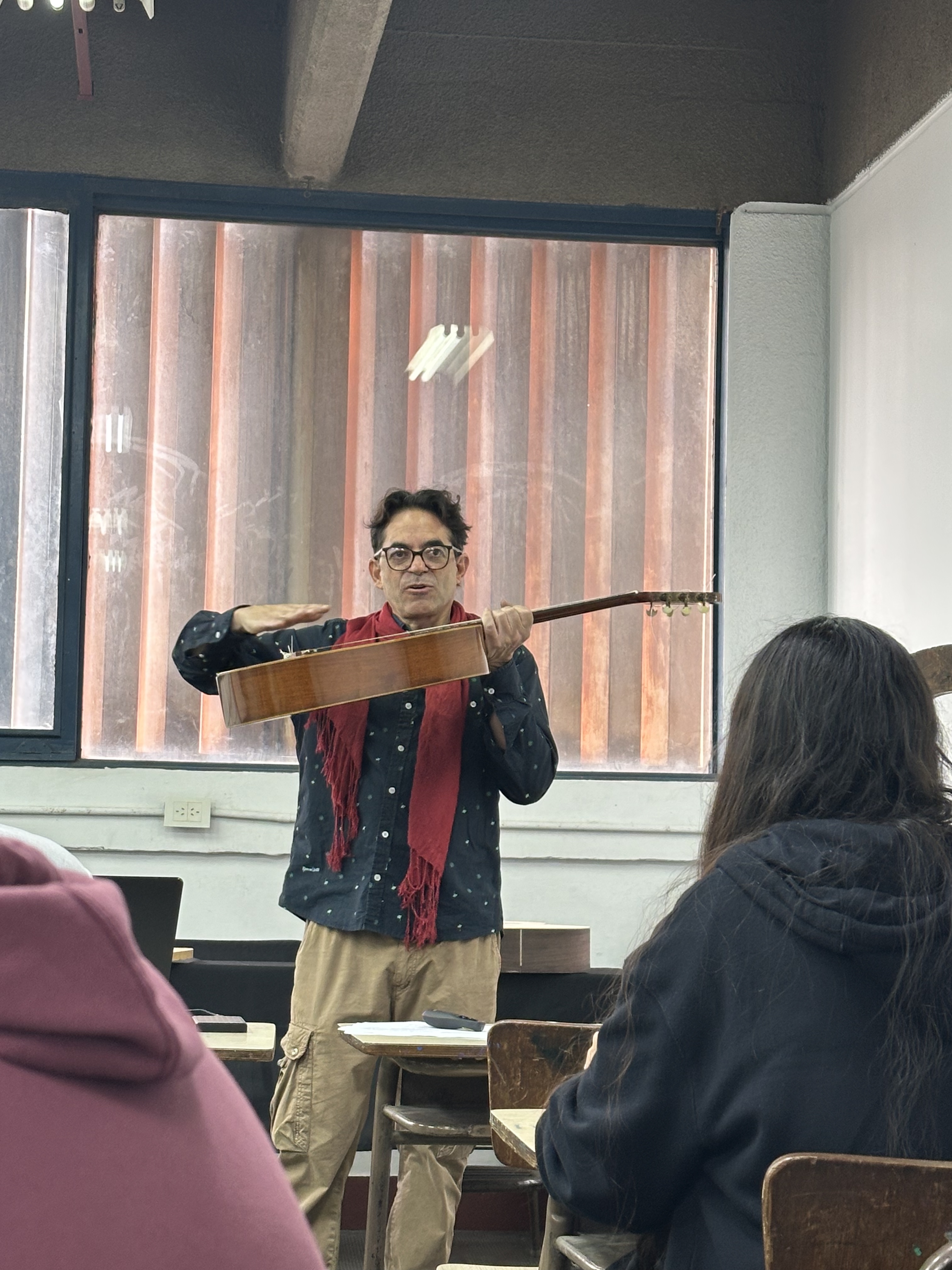
The Universidad Nacional de Tucumán (UNT) in San Miguel de Tucumán, Argentina, houses the Triennial of Lutherie, a vibrant regional celebration of craftsmanship, music, and sustainability. The 6th edition, which I attended, brought together luthiers and enthusiasts for four days filled with lectures, workshops, exhibits, and recitals. Central to this event was the 7th International Building Competition for traditional instruments, notably violins, classical guitars, and charangos. Among the compelling discussions were the final thesis projects of students focusing on sustainability, all advised by professors Viviana Reyes and Sofía Zamora, as well as another lutherie professor of choice. For instance, Vicente Fernandez is developing a comprehensive database analyzing the attributes of instruments crafted at the UNT lutherie program from Argentine wood, while Rodrigo Chavez is experimenting with the sound and acoustics of a violin being made from local algarrobo wood (Neltuma alba, Neltuma nigra). The Guitarra Tucumana, a pivotal product of the UNT lutherie department, showcases ongoing efforts in preserving local musical identity. Redefined through the combined expertise of professors Fernando Silva, Antonio Leiva, and Juan Alonso, the Guitarra Tucumana has evolved into a respected model celebrated for its distinctive design and construction using native woods, particularly algarrobo and nogal (Juglans australis). This project not only highlights the region’s rich musical tradition but also acknowledges the ecological significance of local timber, promoting a sustainable approach to lutherie that connects modern practice with cultural heritage.
Figure 1: Luthier and UNT professor Juan Alonso discussing the Guitarra Tucumana during a workshop at the 6th Triennial of Lutherie. Photo by author, August 2025.
In addition to focusing on sustainability, UNT’s lutherie program champions diversity and inclusivity. Around 30% of students identify as women and non-binary individuals, a significant achievement in a field historically dominated by male master-apprentice dynamics. This representation advances an environment where diverse perspectives on music and craftsmanship can flourish, enriching the learning experience for all.
II. The Guitarra Patagónica – Buenos Aires and Southern Argentina
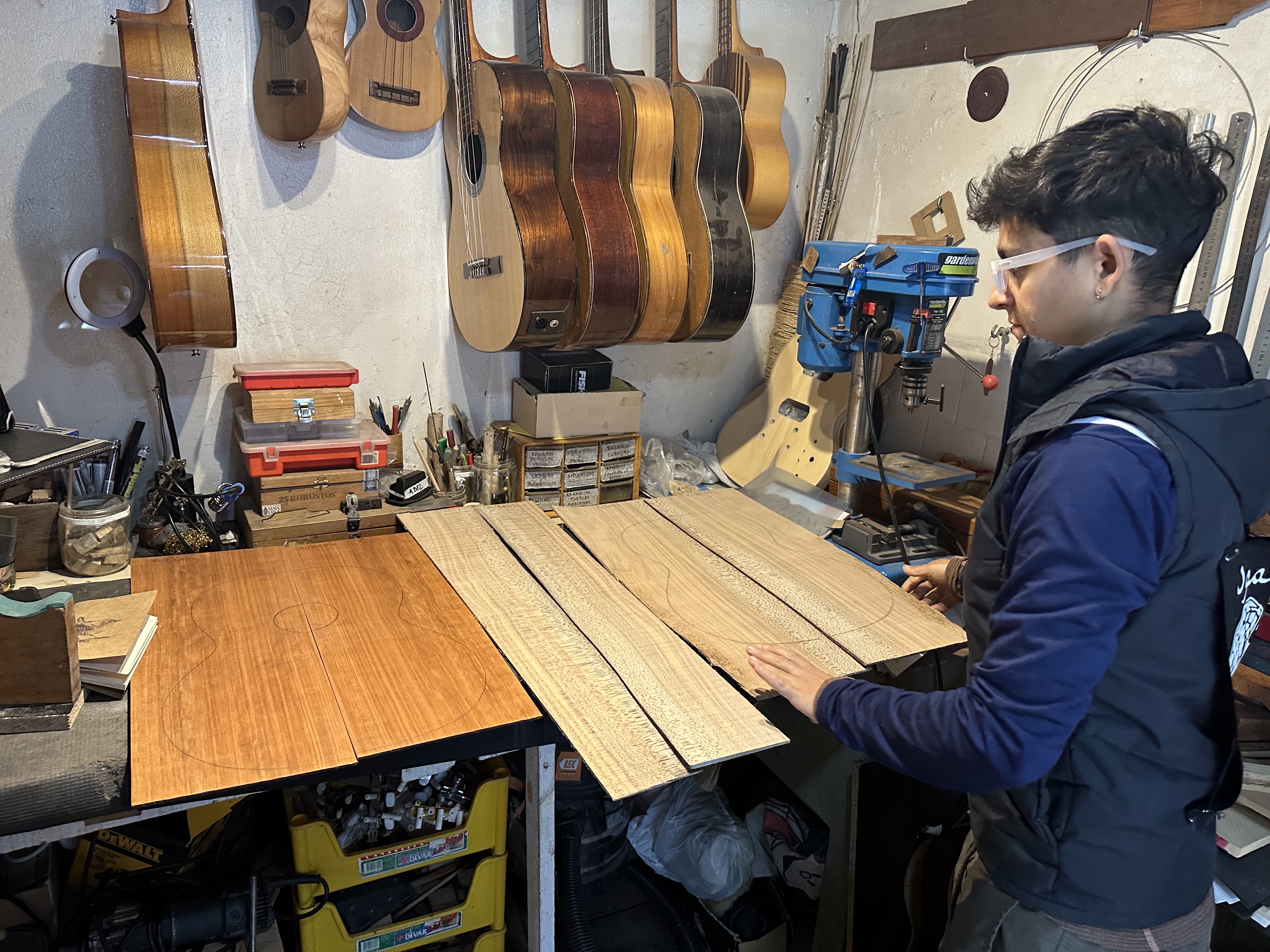
The Guitarra Patagónica is a remarkable embodiment of sustainable lutherie practices in Argentina, driven by the recovery of rare and protected woods from the Patagonian region, specifically alerce (Fitzroya cupressoides) and radal (Lomatia hirsuta). Luthiers from Buenos Aires and Southern Argentina have adopted the practice of using rescued and reclaimed woods, with alerce being notable for its beauty and acoustic excellence. Traditionally sourced from submerged timber due to logging and erosion, the alerce is now retrieved legally from lakes and rivers as live trees are protected. In this context, luthiers like Sebastián Cerieldín have made significant contributions by salvaging this treasured wood along the coastlines of lakes in El Bolsón, Río Negro province. Another skilled artisan, Wayun Luthier, is crafting exquisite instruments, such as piccolo and classical guitars, using both alerce and radal, creating a dialogue between environmental conservation and musical artistry. The Guitarra Patagonica thus stands as a testament to the ethical sourcing of materials and reflects a deep respect for the environment, showcasing how traditional craftsmanship can adapt to contemporary sustainable practices.
Figure 2: Wayun Luthier from Buenos Aires selecting alerce and radal wood for building a Guitarra Patagonica. Photo by author, August 2025.
III. Universidade Federal do Paraná (UFPR) – Curitiba, Brazil
The Lutherie course at the Universidade Federal do Paraná (UFPR), established in 2009, offers a unique higher technical degree designed to meet Brazil’s growing demand for skilled musical instrument builders. This full-time, in-person program spans 6 semesters, with 30 available spots each year, and requires students to pass an entrance exam. The curriculum includes 31 core classes and 14 electives across three modules — Humanities, Fixed Professional, and Exact Sciences — that promote critical thinking and cultural appreciation through practical workshops and extensive academic resources. Additionally, the program emphasizes community engagement and internships, preparing graduates to build and restore high-quality instruments while supporting local craftsmanship and sustainability, ultimately contributing positively to the music community.
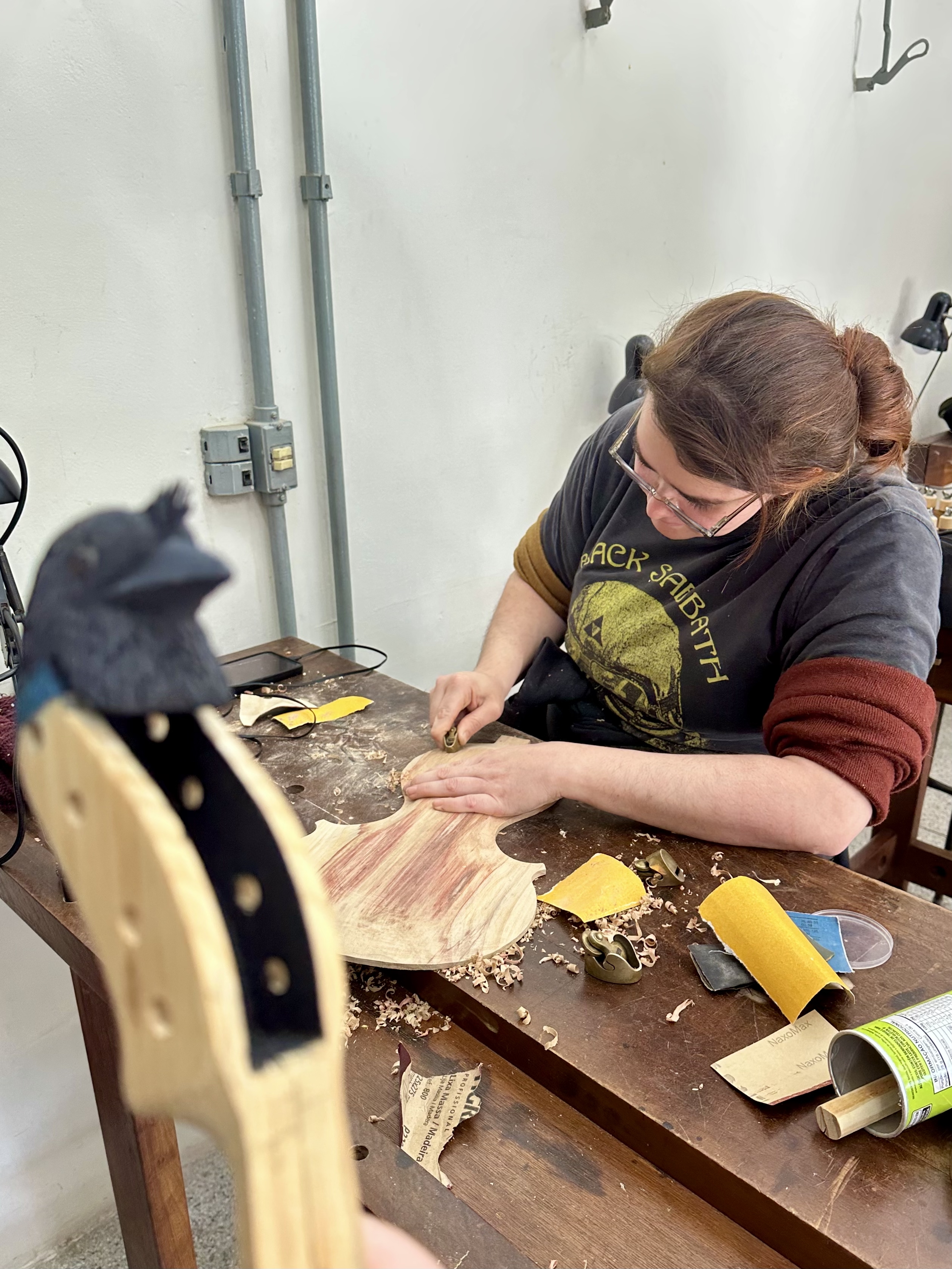
At the Universidade Federal do Paraná (UFPR) in Curitiba, students, under the leadership of professor Juarez Bergmann Filho and guidance of professors like José Roberto do Carmo Júnior, are redefining lutherie education through courses focused on sustainability and cultural connectivity. Students have chosen alternative and sustainable woods for their projects, such as Milton Rocha, who is crafting a Viola Caipira using cerejeira (Amburana cearensis), Volnei Pereira, who is building a classical guitar from marupá (Simarouba amara) and eucalyptus (Eucalyptus grandis), and Fernanda Ferreira, who is making a folkloric Rabeca Caiçara with araucária (Araucaria araucana). This dedication to sustainability instills eco-consciousness among aspiring luthiers and encourages innovation in instrument design.
Importantly, UFPR’s lutherie program also emphasizes inclusivity. Approximately 15% of the student body consists of women and non-binary individuals, marking a significant departure from traditional lutherie environments. The university’s commitment to diversity empowers these students and enriches the program, encouraging a collaborative and supportive atmosphere. The initiatives designed to integrate various identities and backgrounds contribute to a richer educational experience and a genuinely representative musical culture.
Figure 3: UFPR student Fernanda Ferreira building a folkloric rabeca caiçara from araucaria wood. Photo by author, June 2025.
Furthermore, the UFPR has initiated an Organ Restoration Project in Curitiba, first at the Paróquia Santo Antonio-Orleans, uniting faculty and students to resurrect decayed organs in local churches. This collective effort showcases the integration of historical preservation and community service, emphasizing the social responsibility of luthiers and musicians. Through these initiatives, UFPR promotes an education model that intertwines cultural heritage, environmental stewardship, and communal engagement, developing a new generation of luthiers poised to make a positive impact. Together, these case studies illuminate the promise of lutherie as a discipline that bridges tradition and innovation, advancing a musical culture that respects the environment and promotes diversity. Through their commitment to sustainability and inclusivity, these institutions are paving the way for a resilient future in lutherie education, ensuring that the legacy of craftsmanship not only survives but thrives in ever-evolving landscapes.
Conclusion
In conclusion, I argue that the evolution of lutherie education is crucial for the sustainability and relevance of instrument making. Transitioning from traditional apprenticeships to structured academic programs allows for the integration of theoretical knowledge with practical skills. While hands-on experience remains vital, I argue that modern programs can enhance craftsmanship through technologies like CAD and CNC machines, enabling effective design visualization and prototyping. Public educational institutions are essential for developing skilled luthiers by offering accessible courses that promote sustainability and community collaboration. I contend that these multidisciplinary programs, which encompass musicology, acoustics, materials science, design, and engineering, provide a comprehensive understanding of the craft. Involving specific faculty, generalists, industry experts, and local artisans in curriculum development enhances hands-on learning, ensuring that students acquire a solid foundation in essential knowledge, technical skills, and fundamental business insights.
Addressing environmental concerns, public lutherie education emphasizes sustainability, guiding students to adopt eco-friendly practices while honoring traditional methods. The integration of modern technologies encourages innovation and adaptability, essential for navigating the complexities of today’s market. Additionally, community engagement and mentorship initiatives empower aspiring luthiers, promoting creativity and collaboration. Finally, I argue that promoting inclusivity and equity within educational frameworks is necessary to dismantle barriers related to gender, race, and class in the lutherie craft and trade. By developing innovative curricula that uplift underrepresented voices, public lutherie education preserves the rich heritage of the craft and contributes to broader social change. A balanced approach that respects tradition while embracing modern needs will better prepare future luthiers for successful and responsible practices.
References
Dawe, Kevin. 2015. “Materials matter: Towards a political ecology of musical instrument making.” In Current Directions in Ecomusicology, edited by Aaron S. Allen and Kevin Dawe. New York: Routledge.
Dirksen, Rebecca. 2019. “Haiti’s Drums and Trees: Facing Loss of the Sacred.” Ethnomusicology 63, no. 1: 43-77.
Evans, Tina Lynn. 2015. “Transdisciplinary Collaborations for Sustainability Education: Institutional and Intragroup Challenges and Opportunities.” Policy Futures in Education 13, no. 1: 70-96.
Frater, Judy. 2019. “Education for Artisans: Beginning a Sustainable Future for Craft Traditions.” In A Cultural Economic Analysis of Craft, edited by Anna Mignosa and Priyatej Kotipalli. New York: Springer International Publishing.
Frater, Judy. 2020. “From Kala Raksha Vidhyalaya to Somaiya Kala Vidya: Education as a Sustainable Future for Artisans of Kutch and Beyond Education for Artisans of Kutch and Beyond,” Global Journal of Intangible Cultural Heritage 6.
Gibson, Chris, and Andrew Warren. 2021. The Guitar: Tracing the Grain Back to the Tree. Chicago: University of Chicago Press.
Gibson, Chris, and Andrew Warren. 2016. “Resource-sensitive global production networks: Reconfigured geographies of timber and acoustic guitar manufacturing.” Economic Geography 92, no. 4: 430-454.
Godemann, Jasmin. 2008. “Knowledge integration: A key challenge for transdisciplinary cooperation.” Environmental Education Research 14, no. 6: 625-641.
Grobar, Lisa M. 2017. “Policies to Promote Employment and Preserve Cultural Heritage in the Handicraft Sector.” International Journal of Cultural Policy 25 (4): 515–27.
Martinez-Reyes, Jose. 2021. “Timber to Timbre: Fijian Mahogany Plantations and Gibson Guitars.” In Plantations, Fijian Mahogany, and Gibson Guitars. Audible Infrastructures: Music, Sound, Media edited by Kyle Devine and Alexandrine Boudreault-Fournier, 93-116. New York: Oxford University Press.
Tasdemir, Cagatay, and Rado Gazo. 2020. “Integrating sustainability into higher education curriculum through a transdisciplinary perspective.” Journal of Cleaner Production 265: 121759.
Tucker, Joshua. 2016. “The Machine of Sonorous Indigeneity: Craftsmanship and Sound Ecology in an Andean Instrument Workshop.” Ethnomusicology Forum 25 (3): 326–44.
Xing, Taining and Nailiang Chen. 2024. “Evolution of education models in European musical instrument manufacturing: From traditional apprenticeships to modern academic systems.” Arts Educa 39: 342-356.
Yamada, Keisuke. 2017. “Shamisen Skin on the Verge of Extinction: Musical Sustainability and Non-Scalability of Cultural Loss.” Ethnomusicology Forum 26 (3): 373–96.
Online Sources
Lutheria UFPR. “Curso Superior de Tecnologia em Luteria-Univrsidade Federal do
Lutherie refers to the construction and maintenance of musical instruments, with a focus, according to history, on handcrafted wooden stringed instruments. The term refers to the French word luth (or liuto in Italian), which is why luth (lute) builders were called luthiers. As instruments evolved, luthiers began building guitars, violins, violas, cellos, and, more recently, electric guitars and basses. Thus, the word ended up acquiring a generic meaning. Nowadays, the use of the word luthier is accepted and widespread to generically designate builders of various musical instruments, not only made of wood, including aerophones, membranophones, idiophones, electronic, and digital instruments (“Curso Superior de Tecnologia em Luteria-Univrsidade Federal do Paraná.” Updated November 2025. http://www.luteria.ufpr.br/portal/) ↑
*Rubens De La Corte (he/him) is a fifth-year Ph.D. candidate in ethnomusicology with an advanced certificate in Women’s and Gender Studies at the CUNY Graduate Center. Rubens focuses on organology and its intersections with gender, sexuality, material culture, and the cultural geographies of music. Rubens concentrates his research on Latin America and the Lusophone domain. Rubens has a BA in Architecture and Urban Studies from the University of São Paulo, Brazil, a dual BA in Guitar and Jazz Composition from Berklee College of Music, an MA in Jazz Studies from CUNY Queens College, and an MA in Ethnomusicology from Stony Brook University. Rubens is also a guitarist, composer, and arranger, having worked with numerous artists, including a ten-year tenure as musical director for West African artist and five-time Grammy winner Angelique Kidjo, as well as seventeen years in the quartet of two-time Grammy and two-time Latin Grammy winner Brazilian jazz pianist Eliane Elias.